Submit News
 About us
 Advertise
 Contact us

 Aug 10, 2026
  2 min read

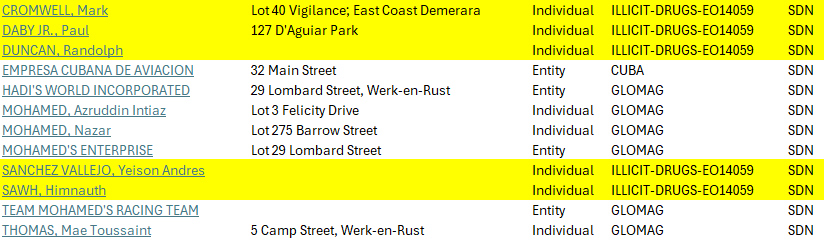
Attorney General Anil Nandlall has reiterated the serious implications that will flow from association with the Mohamed family, who have been sanctioned by the United States Office of Foreign Assets Control (OFAC) in relation to money laundering.
Speaking on his talk show Issues in the News on Tuesday, Nandlall weighed in on several persons close to presidential candidate Azruddin Mohamed losing their local bank accounts. He said that the banks would have determined a threat to the financial system and moved to ensure its protection. Demerara Bank and, most recently, the Guyana Bank of Trade and Industry (GBTI) have closed accounts belonging to candidates of the We Invest in Nationhood (WIN) party.
“Once one commercial bank moves in this direction it means that they have determined a threat in the financial system; and the financial system is interconnected. And once there is a threat somewhere in the system it will contaminate the entire system and other banks will have to follow suit,” he said.
The Attorney General noted that this is how the Anti-Money Laundering and Countering the Financing of Terrorism (AML/CFT) framework operates to ensure that financial institutions act appropriately in response to those involved in financial crimes.
OFAC enforces economic and trade sanctions to counter threats such as money laundering, terrorism, and corruption. Sanctions typically involve freezing assets and prohibiting US entities from engaging with targeted individuals, businesses, or countries. Violating these sanctions can lead to serious penalties, including fines and criminal charges. OFAC sanctions also carry wider consequences, as anyone dealing with sanctioned parties may face secondary sanctions and legal or reputational fallout, impacting national financial systems and international relations.
Both Azruddin and his father Nazar “Shell” Mohamed are sanctioned by OFAC for gold smuggling, tax evasion, and corruption.
Recently, US Ambassador to Guyana Nicole D. Theriot told the local media that the US is concerned if Mohamed is elected to Parliament, noting the negative impact it will have on business and diplomatic relations between the two countries.
If elected to Parliament, Mohamed becomes part of the governance structure, and there will be repercussions, the Attorney General stated.
“That is a statement of fact,” he insisted, adding that “ The Guyanese electorate will have to deal with that and the Guyanese people will have to deal with that, and that is why we are saying this is not a normal competitor, this is a person if elected he will expose the country to harm, he has already exposed the persons associated with him to harm, visas have been revoked and persons are being questioned at airports.”
The Attorney General said that Guyana has already experienced the effects of a contaminated system when the country was blacklisted. Operators of the local financial system is cognisant of how sanctions operate and is thus taking the appropriate required steps to ensure its protection, he noted.

Young cricketers vie for Under-13 spots as DCB tour...
Forty young cricketers from three teams will battle for spots on Demerara’s Under-13 squad when the Demerara Cricket Board’s 2026 Under-13 Tournament...