Washington and Carse light up Lord’s as gripping finish looms

I ndia 387 and 58 for 4 (Rahul 33, Carse 2-11) need 135 runs to beat England 387 and 192 (Root 40, Washington 4-22, Siraj 2-31, Bumrah 2-38)*

Washington Sundar’s decisive spell set India up for a 135-run chase on the final day of the third Test at Lord’s, but in a twist to an enthralling fourth day—during which 14 wickets fell—they only have six wickets in hand.

Brydon Carse removed Karun Nair and Shubman Gill cheaply to return impressive figures of 2 for 11 from four overs, and Ben Stokes bowled nightwatchman Akash Deep with the final ball of the day, as three wickets fell in the last half-hour of play.

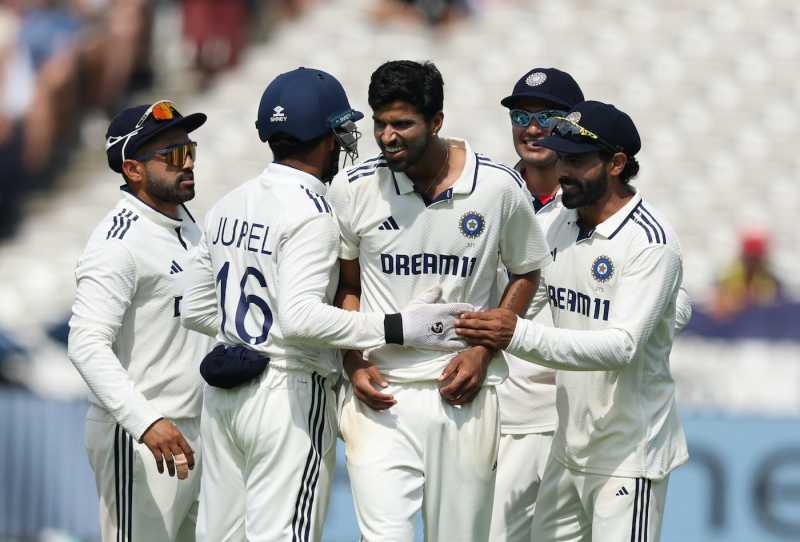
Washington’s 4 for 22 included the key scalps of Joe Root, Jamie Smith and Stokes, before he claimed the final England wicket—Shoaib Bashir—as the hosts set a target of 193, following first-innings parity.

Jofra Archer struck early in India’s chase, when Yashasvi Jaiswal attempted to pull a short, wide delivery and top-edged it into the air above wicketkeeper Smith.

But it wasn’t until 30 minutes before stumps that England broke through again—Nair was flummoxed by Carse’s nip-backer and offered no shot as the ball struck the inside of his back knee. Gill, on 6, failed to overturn an lbw decision after being struck on the knee roll by one in line with middle stump.

When Akash Deep came to the crease—still needing to don his arm guard and gloves—Root revved up the crowd in protest at any perceived time-wasting, echoing Gill’s frustration in a heated exchange with Zak Crawley at the end of day three.

The situation moved from prickly to farcical to downright amusing when Carse rapped Akash Deep on the pads. He survived England’s review on umpire’s call with impact on the top of leg stump, and India called for the physio to strap the batter’s leg, eating up more time.

Nonetheless, England squeezed in one more over, and Stokes struck with the fourth ball—flattening Akash Deep’s off stump.

India’s bowlers had earlier started the day with great intent. Jasprit Bumrah troubled Crawley significantly without reward, and Mohammed Siraj bowled a miserly seven-over opening spell that yielded two wickets.

Ben Duckett was the first to fall, pulling to Bumrah at mid-on, amid a fiery send-off from Siraj that ensured tensions from the previous evening remained high.

Siraj then pinned Ollie Pope lbw—though it took an Indian review to confirm his dismissal for just 4 off 17 balls. Pope’s second-innings average now languishes at just 19.64.

Nitish Kumar Reddy replaced Bumrah midway through the morning session and removed Crawley for the second time in the match—this time to a loose drive outside off stump, taken sharply by Jaiswal at gully.

Harry Brook counterattacked briefly, ramping Akash Deep for consecutive fours before launching him down the ground for six. But his cameo was short-lived—he fell for a 19-ball 23 when, attempting to sweep a full, straight delivery, Akash Deep flattened his middle stump in the perfect riposte.

Enter Washington after lunch, as India turned to spin. He rattled Root’s middle stump with one that slid under the attempted sweep, breaking a 67-run fifth-wicket stand with Stokes. Root’s 40 ended as England’s highest score of the innings and broke his run of four fifties at Lord’s, which included three centuries on the trot.

Four overs later, Washington bowled Smith for just 8 with a quicker ball that didn’t turn but skidded past the outside edge onto off stump.

At that stage, England were 164 for 6 and subsequently became becalmed as Stokes and Chris Woakes looked to prevent further damage.

Stokes added only six more runs after tea before Washington struck again—beating the slog sweep and clattering middle stump to dismiss him for 33.

Bumrah was eventually rewarded with the wickets of Carse and Woakes—the former to a stunning, pinpoint yorker on leg stump, the latter to a delivery that expertly clipped the leg-side bails.

Bashir became India’s 12th bowled dismissal in the match when Washington beat his defence to close out the innings—completing an England collapse in which they lost their last four wickets for 11 runs, and six for 38 overall.

Washington’s 4 for 22 marks the best figures by an Indian spinner at Lord’s since 1974. (ESPNcricinfo)
Daren Sammy talks up returning Shamar Joseph

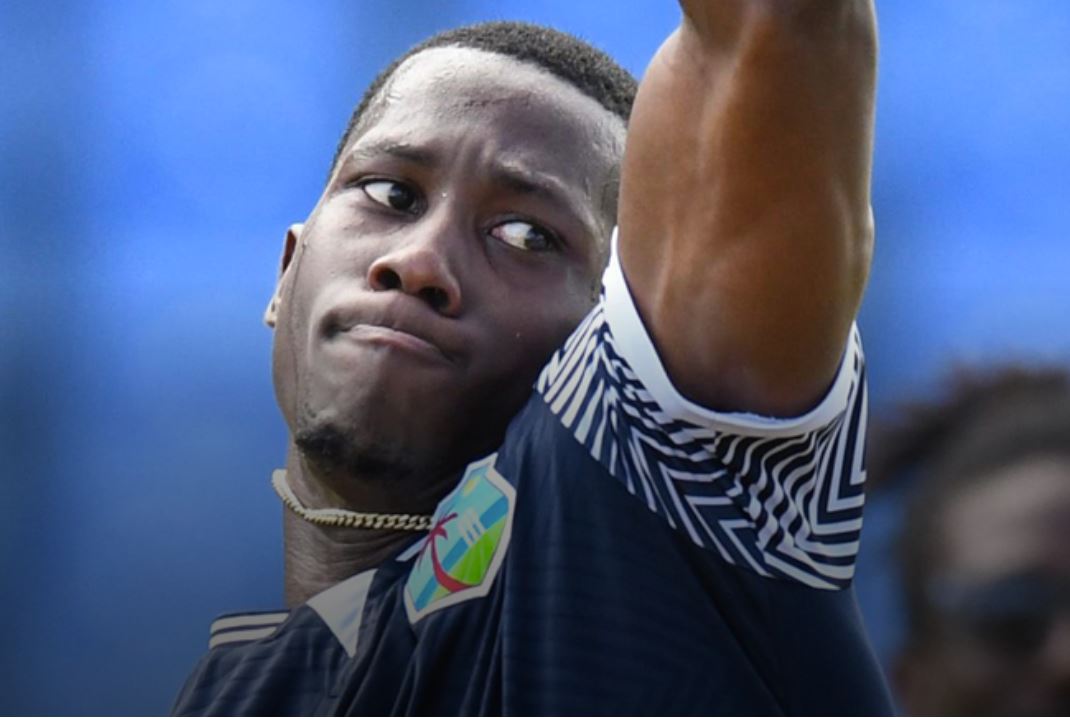
West Indies head coach Daren Sammy is excited to see Shamar Joseph return to the international stage and was hugely impressed by the showing in the nets during the ongoing camp at Kensington Oval.
Sammy oversaw an intense seven-hour “training day” as West Indies look ahead to the first Test against Australia, which bowls off next Wednesday. The focus was on the workload of the young fast bowlers and Shamar Joseph was particularly impressive in a 36-ball burst from the Malcolm Marshall End.
“Today was a full day of ‘Test’ cricket as we had game-sense training. It was good to see Shamar run in and bowl those really good areas and so did all the other bowlers. The ability to consistently hit that six-metre mark was good to see and I enjoyed seeing the bowlers firing,” Sammy said.
In January 2024, the 24-year-old made a dramatic entrance to the international scene in a dramatic Test debut against Australia at the Adelaide Oval. He dismissed Steve Smith with his first delivery in Test cricket and took five wickets in the match. He followed this up with a superb match-winning spell of 7-68 at the Gabba in Brisbane, leading the West Indies to their first Test victory in Australia in 27 years.
“Shamar, since he announced himself on the Test arena against Australia in these two Test matches Down Under, I would love to see him repeat those kinds of performances in the coming weeks here on home soil. We went back to see the preparations he had then, and the kind of work he had in his legs, and we tried to recreate that kind of situation,” Sammy said. (Jamaica Observer)

India great Kohli retires from Test cricket

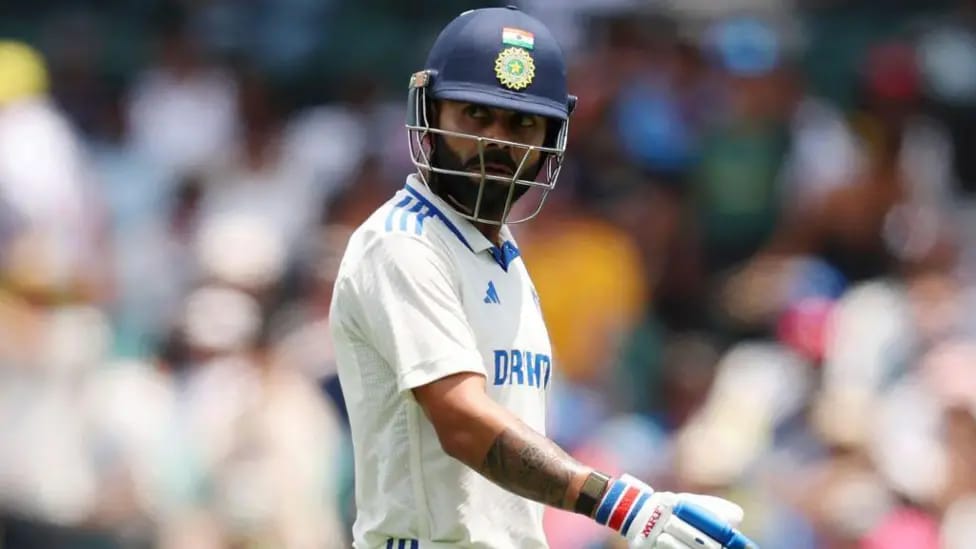
Legendary India batter Virat Kohli has announced his immediate retirement from Test cricket.
His decision comes before this summer’s five-Test tour of England, which starts on 20 June, and follows captain Rohit Sharma’s retirement on Wednesday.
Kohli, 36, has played 123 Tests for India and scored 9,230 runs at an average of 46.85.
“It’s been 14 years since I first wore the baggy blue in Test cricket,” Kohli posted on social media.
“Honestly, I never imagined the journey this format would take me on. It’s tested me, shaped me, and taught me lessons I’ll carry for life.”
Kohli retired from T20 internationals in 2024, after India’s World Cup victory, but is expected to continue playing one-day internationals.
After making his Test debut against West Indies in 2011, Kohli went on to captain India in 68 of his Tests, with his 40 wins in charge making him the country’s most successful leader in the format.
“There’s something deeply personal about playing in whites. The quiet grind, the long days, the small moments that no-one sees but that stay with you forever,” he added.
“As I step away from this format, it’s not easy – but it feels right. I’ve given it everything I had, and it’s given me back so much more than I could’ve hoped for.
“I’m walking away with a heart full of gratitude – for the game, for the people I shared the field with, and for every single person who made me feel seen along the way. I’ll always look back at my Test career with a smile.”

Kohli has long been regarded as one of the four batting greats of his era, alongside England’s Joe Root, Australia’s Steve Smith and New Zealand’s Kane Williamson, and has scored 30 Test centuries.
Only Sachin Tendulkar, Rahul Dravid and Sunil Gavaskar have scored more Test runs for India than Kohli, while he has the most centuries for an India captain with 20.
But his most recent Test ton, 100 not out in the first Test against Australia in November, was his first in 15 innings across 16 months.
During that series, he scored 190 runs in nine innings, averaging just 23.75.
Only three tons have come in 39 Tests since January 2020. He averages 30.72 in that time.
And so cricket’s greatest showman leaves its grandest stage. Not with a final century, wave of the bat or guard of honour, but with a post to his 271m Instagram followers. The end of an aura.
It is hard to overstate Kohli’s fame, stardom or influence. He is the biggest presence in the most powerful cricketing nation on the planet. Maybe his name does not travel globally like a Ronaldo or Messi, yet even those two titans will have no idea what it feels like to be Virat Kohli in India.
As a batter, Kohli continued the talismanic lineage of Gavaskar, Azharuddin and Tendulkar. His cover drive is a work of art. In 2018, a Kohli net session in Adelaide went viral, the ball leaving the bat with the sound of a pistol being fired. He is the first of the Fab Four to leave Test cricket and while his numbers do not stack up to Smith, Root and Williamson, Kohli is the most pleasing to watch.

As a leader, Kohli dragged the India Test side into the 21st century. Having more Test wins than any other India captain is statistically significant, though that pales when compared to what Kohli did for his team and Test cricket itself.
It is not an exaggeration to say Kohli was the most important factor in upkeeping the relevance of the longest format when it could otherwise have been completely swallowed by the T20 leagues.
Kohli follows Rohit Sharma into retirement as the regeneration of the India Test team continues. The XI that lines up to face Headingley in late June will have an unfamiliar feel. There may be more one-day internationals to savour. In that format, Kohli really is the GOAT.
Even with the histrionics, everything he did was must-see. Without Kohli, Test cricket will be a poorer spectacle. (BBC Sport)