Nascimento warns Venezuela must never be taken for granted

Communications specialist and political commentator Kit Nascimento says Guyana must take nothing for granted and remain alert and prepared to defend the resource-rich Essequibo, which he described as the country’s most immediate strategic challenge.

Speaking on Monday during a panel discussion marking Guyana’s 60th Independence Anniversary, Nascimento said Venezuela has maintained its position that it does not submit to the jurisdiction of the International Court of Justice in the border controversy.

He referred to recent oral hearings in the Essequibo case, during which legal representatives of Venezuela and Acting President Delcy Rodríguez rejected the court’s authority to hear the matter.

“A ruling of the International Court of Justice in our favour will not automatically avoid that threat,” he said.

Nascimento urged continued vigilance, saying Guyana must protect its future and remain prepared for any developments affecting its western border.

“I conclude by saying to all of us, we must always prepare ourselves to meet and overcome that challenge,” he added.

The ICJ is expected to issue its decision in the Essequibo case in January 2027. The ruling will be final and binding. Guyana has expressed confidence in a favourable outcome.

Guyana rejects Venezuela objection, says seismic survey within EEZ

Guyana has rejected Venezuela’s objection to a planned seismic survey in its maritime territory, saying the activities fall squarely within its Exclusive Economic Zone (EEZ) and are fully consistent with international law.
In a statement on Thursday, the Government of Guyana said it “categorically rejects” claims by Venezuela that the three-dimensional multi-client seismic exploration programme would take place in “undelimited maritime areas,” describing the assertions as legally unfounded and inaccurate.
The government said the seismic survey will be conducted within maritime areas that belong to Guyana under the 1899 Arbitral Award, which established the boundary between then British Guiana and Venezuela.
According to the statement, Guyana exercises sovereignty up to 12 nautical miles in its territorial sea and sovereign rights beyond that limit within its Exclusive Economic Zone and continental shelf. Those rights include the authority to explore, exploit, conserve and manage natural resources in those areas.
“Guyana’s decision to facilitate the acquisition of high-resolution seismic data through a 3D Multi-Client Seismic Survey represents a legitimate and lawful exercise of its rights,” the government said.
The government added that the seismic programme forms part of a broader strategy to strengthen scientific understanding of Guyana’s offshore petroleum basin, improve resource management and increase the attractiveness of the country’s offshore acreage to international investors.
The survey will use advanced geophysical techniques to generate high-resolution subsurface images to support exploration planning and the long-term governance of the offshore energy sector, the statement said.
Guyana also rejected Venezuela’s claim that the activities fall within undelimited maritime areas, saying the country has consistently exercised peaceful administration over its maritime spaces, including licensing and regulating offshore exploration.
The government noted that the boundary between the two countries was settled more than a century ago by the 1899 Arbitral Award, which it said provided legal certainty for both states.
It also recalled that the 1966 Geneva Agreement governs the process to address Venezuela’s claim that the arbitral award is null and void, adding that the agreement does not prevent Guyana from carrying out economic development activities in its territory or maritime areas.
Guyana further said Venezuela’s statement that it would not recognise concessions, licences or activities authorised by Guyana in its maritime domain has no legal effect under international law.
The government called on Venezuela to refrain from what it described as inflammatory and misleading statements that could undermine Guyana’s sovereign rights or discourage legitimate economic activity within its maritime domain.

US seizes Guyana-flagged Venezuela-linked tanker ahead of Trump-Machado meeting

(Reuters) The U.S. has seized another Venezuela-linked tanker, US officials told Reuters on Thursday, ahead of a meeting between U.S. President Donald Trump and Venezuelan opposition leader Maria Corina Machado.

The seizure marks the sixth vessel targeted since mid-December that was either carrying Venezuelan oil or had done so in the past. The officials, speaking on the condition of anonymity, said the seizure took place in the Caribbean.

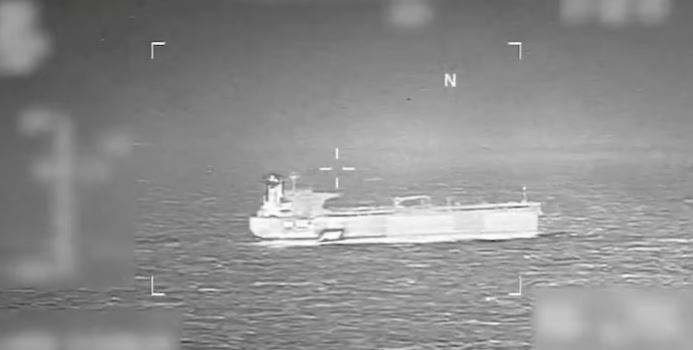
The U.S. military’s Southern Command confirmed the pre-dawn operation, saying U.S. forces apprehended Motor/Tanker Veronica “without incident.” It said the Veronica was “operating in defiance of President Trump’s established quarantine of sanctioned vessels in the Caribbean.”
“The only oil leaving Venezuela will be oil that is coordinated properly and lawfully,” Southern Command said in a statement.
Guyana-flagged Aframax tanker Veronica departed empty from Venezuelan waters in early January, according to shipping documents from state company PDVSA and monitoring service TankerTrackers.com. The vessel had not returned to Venezuela as other ships have done in recent days.
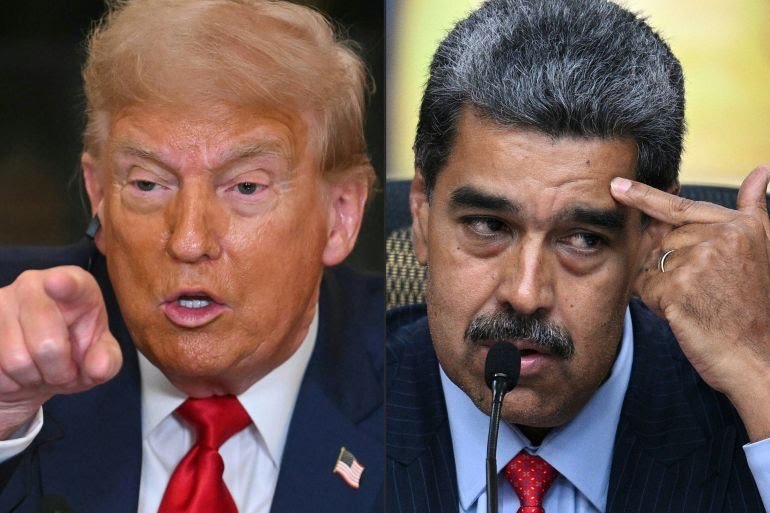
The seizures began as part of Trump’s campaign to force Venezuelan President Nicolas Maduro out of power, which culminated in U.S. forces swooping into the country to grab him and his wife on January 3.
Since then, Trump has said the U.S. plans to control Venezuela’s oil resources indefinitely as it seeks to rebuild the country’s dilapidated oil industry in a $100 billion plan.
The U.S. government has filed for court warrants to seize dozens more tankers linked to the Venezuelan oil trade, four sources told Reuters on Wednesday, as Washington consolidates control of oil shipments in and out of the South American country.
The vessels intercepted so far have been either under U.S. sanctions or part of a “shadow fleet” of ships that disguise their origins to move oil from major sanctioned producers — Iran, Russia or Venezuela.
Most of the Venezuela-linked vessels seized so far were flying fake flags or their flag registrations had been cancelled before the interceptions, the maritime authorities of Panama, Cook Islands and Guyana have told Reuters.
Last week, the U.S. seized a Russian-flagged oil tanker that was being shadowed by a Russian submarine after pursuing it for more than two weeks across the Atlantic.
The move was condemned by Moscow.
The latest seizure came ahead of Thursday’s meeting between Trump and Machado, in their first face-to-face meeting since the U.S. ousted her long-time foe, Maduro.
Trump has previously called her a “freedom fighter” but dismissed the idea of installing her to lead Venezuela after ousting Maduro, saying she did not have enough domestic support.
A classified CIA assessment presented to Trump concluded that Maduro loyalists, including Rodriguez, were best positioned to maintain stability.

Trump’s Venezuela takeover will make Guyana oil safer

(Oilprice.com) A couple of years ago, Venezuela’s government decided to revive a territorial claim over much of its neighbour, Guyana. The tiny country was emerging as a major oil producer, and Venezuela wanted a piece. Then came Trump and removed the head of that government.
Essequibo lies between Guyana and Venezuela, with both claiming sovereignty, while Venezuela is planning a referendum on Sunday to determine the territory’s ownership future.
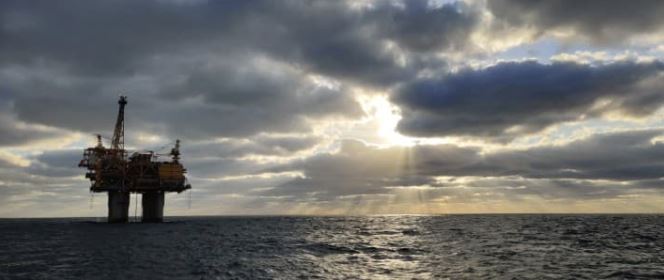
The 61,000+ square mile territory represents about two-thirds of Guyana’s territory and is also the site of a string of huge offshore oil discoveries by Exxon. Those discoveries, the first of which was announced in 2015, were what reinvigorated Venezuela’s claim on the territory.
Over the ten years since then, Exxon and its partners in the Stabroek Block have tapped reserves estimated at over 11 billion barrels of crude, and Guyana’s production is rising in leaps and bounds. Last year, Exxon reported output of over 660,000 barrels daily in mid-2025, rising further to 900,000 barrels daily, eyeing production capacity of as much as 1.7 million barrels daily by 2030. But Nicolas Maduro’s ambitions in Essequibo were threatening that.

Now, with the Venezuelan president ousted by the United States, analysts believe oil production in Guyana will go more smoothly, without the risk of the country ceding two-thirds of its territory to its larger neighbour.

“Sighs of relief will have been exhaled in some offices, particularly on the ground, because that’s a constant threat whether you’re trying to manage logistics and so on, or making sure that ships are getting around safely,” Verisk Maplecroft analyst Eileen Gavin told CNBC this week. “These are all offshore facilities — and highly expensive ones at that. So, having the U.S. armada, as they are calling it, is certainly helpful,” she added.

Some noted that an actual incursion by Venezuela into Essequibo was unlikely to begin with, because it would have triggered an immediate U.S. response to protect business interests in oil.

“With Venezuela already in the US’s crosshairs and Exxon the largest operator in Guyana, any aggression would likely have elicited a US response,” Morningstar director of equity research Allen Good told CNBC.

“Now, with the US’s intent to control the country, any action by Venezuela becomes even more remote, removing a nuisance for Exxon and Guyana,” Good noted.

That would be most welcome news to Exxon, which has turned Guyana’s Stabroek Block into a prominent jewel in its crown. Low breakeven costs, massive reserves to recover, and a friendly government determined to make the best of its resources without succumbing to the so-called oil curse—Guyana was a jackpot for Exxon.

It may well be this fact that made chief executive Darren Woods tell President Trump Venezuela was uninvestable without some serious reforms, prompting, in turn, a threat to lock the company out of Venezuela. Would Exxon care? No, it would not because it is the operator of Guyana’s only commercial oil project to date and is reaping all the benefits of that position.
“We’re in a depletion business for a product that is in great demand and will be in demand for many, many, many decades to come,” Darren Woods told President Trump at last week’s meeting with the industry. “And as a depletion business, the biggest challenge we have is finding resources,” Exxon’s top executive also said.

Woods was speaking about Venezuela and the potential opportunities—and challenges there, but at the same time, his speech highlighted all the points that made Guyana a much better bet. It certainly has the resources, it has the investment-friendly legal framework, and, not least, it has no crippling U.S. sanctions to interfere with oil production. Now, with the removal of a Venezuelan incursion, all will be going even better for Exxon in Guyana.

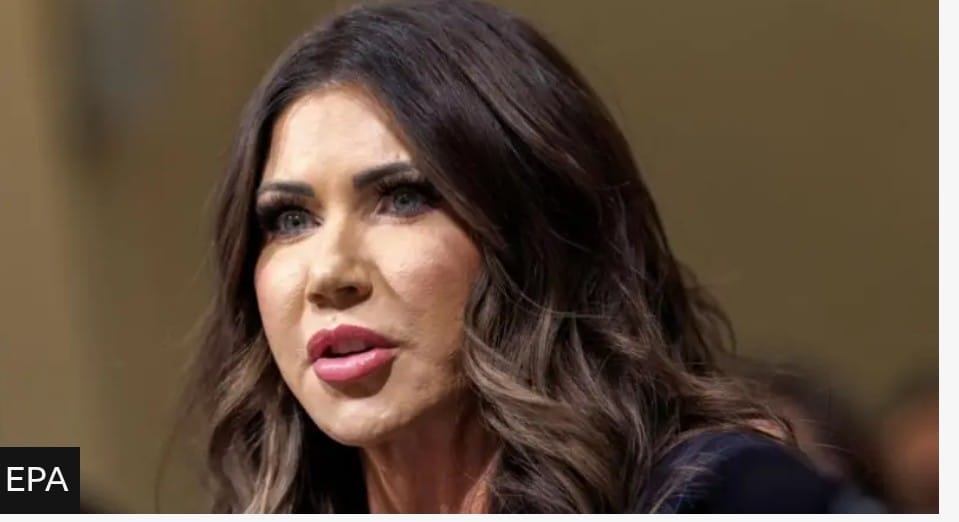
Trump told Venezuelan interim president to ‘lead, or get out the way’ — Kristi Noem

U.S. President Donald Trump is holding discussions with Venezuela’s interim president, Delcy Rodríguez, on the administration of the country, U.S. Homeland Security Secretary Kristi Noem said.

Speaking to Fox News, Noem described the talks as “very matter-of-fact and very clear,” adding that U.S. policy would not tolerate actions she said undermined American influence.

“You can lead or you can get out of the way,” Noem said. “We’re not going to allow you to continue to subvert our American influence.”

Asked whether Venezuelan President Nicolás Maduro could be extradited following his trial, Noem said it was too early to say, adding that the process should be allowed to proceed. (BBC News)

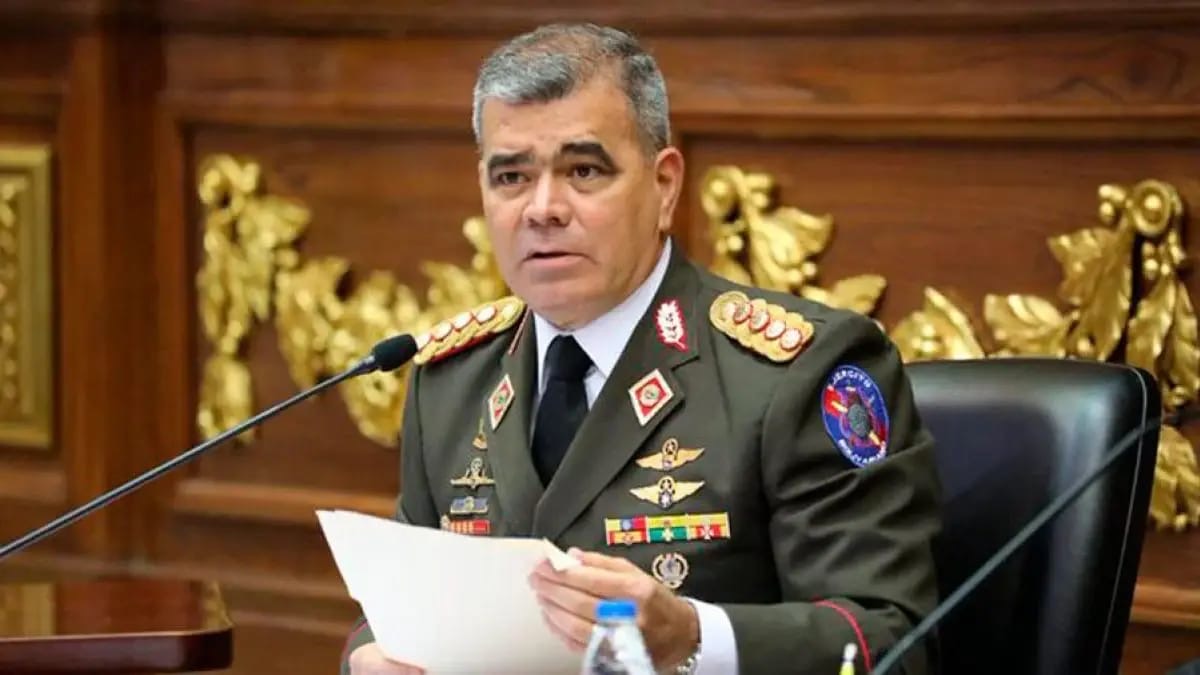
‘Large part’ of Maduro’s security team, ‘innocent civilians’ killed in US operation, says Venezuela’s defence minister

Venezuela’s Defence Minister Vladimir Padrino said on state television that a “large part” of President Nicolás Maduro’s security team, along with soldiers and civilians, were killed during the U.S. operation that led to the capture of Maduro and his wife.

Padrino said the armed forces “firmly reject what he described as the cowardly kidnapping” of the president, accusing the United States of carrying out a “cold-blooded murder” during the operation.

Earlier, the New York Times reported that an apartment complex was struck and that at least 40 people were killed, though it was unclear how many were civilians or military personnel. Reuters has not been able to independently verify those figures. (BBC News)

Spies, drones and blowtorches: How the US captured Maduro

For months, US spies had been monitoring Venezuelan President Nicolas Maduro’s every move.

A small team, including one source within the Venezuelan government, had been observing where the 63-year-old slept, what he ate, what he wore and even, according to top military officials, “his pets.”

Then, in early December, a planned mission dubbed “Operation Absolute Resolve” was finalized. It was the result of months of meticulous planning and rehearsals, which even included elite US troops creating an exact full-size replica of Maduro’s Caracas safe house to practise their entry routes.

The plan — which amounted to an extraordinary US military intervention in Latin America not seen since the Cold War — was closely guarded. Congress was not informed or consulted ahead of time. With the precise details set, top military officials simply had to wait for the optimal conditions to launch.

They wanted to maximize the element of surprise, officials said on Saturday. There was a false start four days earlier when President Trump gave approval, but they opted to wait for better weather and less cloud cover.

“Over the weeks through Christmas and New Year, the men and women of the United States military sat ready, patiently waiting for the right triggers to be met and the president to order us into action,” General Dan Caine, the nation’s highest-ranking military officer, told a news conference on Saturday morning.

Good luck and Godspeed

The order from the president to begin the mission finally came at 22:46 EDT on Friday.

“We were going to do this four days ago, three days ago, two days ago, and then all of a sudden it opened up. And we said: Go,” Trump himself told Fox & Friends on Saturday in the hours after the overnight raid.

“He said to us, and we appreciate it… good luck and Godspeed,” Gen Caine said. Trump’s order came shortly before midnight in Caracas, giving the military most of the night to operate in darkness.

What followed was a two-hour and twenty-minute mission by air, land, and sea that stunned many in Washington and around the world. In terms of scale and precision, it was virtually unprecedented. And it drew immediate condemnation from several regional powers, with Brazil’s President Lula da Silva saying the violent capture of Venezuela’s leader set “yet another extremely dangerous precedent for the entire international community.”

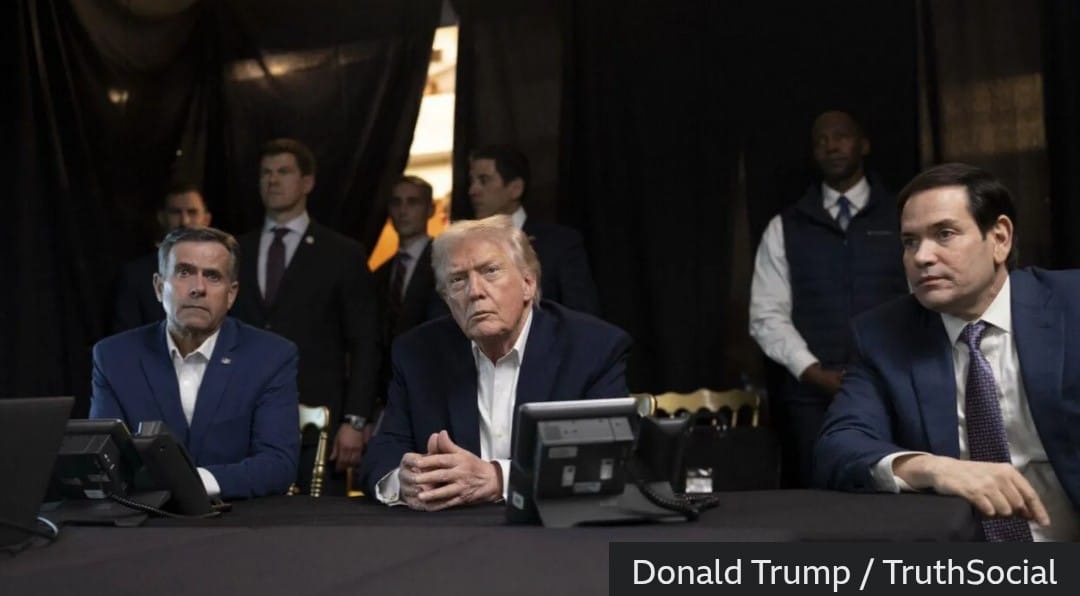
Trump did not follow the mission from the White House situation room. Instead, he was surrounded by his advisers at his Mar-a-Lago club in Palm Beach, Florida, where he watched a live stream of the operation flanked by CIA Director John Ratcliffe and Secretary of State Marco Rubio.

“It was an incredible thing to see,” Trump said on Saturday. “If you would have seen what happened, I mean, I watched it literally like I was watching a television show. And if you would’ve seen the speed, the violence… it’s just, it was an amazing thing, an amazing job that these people did.”

In recent months, thousands of US troops have deployed to the region, joining an aircraft carrier and dozens of warships in the largest military build-up in decades as President Trump has accused Maduro of drug-trafficking and narco-terrorism, and blown up dozens of small boats accused of ferrying drugs through the region.

But the first signs of Operation Absolute Resolve were in the skies. More than 150 aircraft — including bombers, fighter jets, and reconnaissance planes — were ultimately deployed through the course of the night, according to US officials.

“It was very complex, extremely complex, the whole manoeuvre, the landings, the number of aircraft,” Trump told Fox News. “We had a fighter jet for every possible situation.”

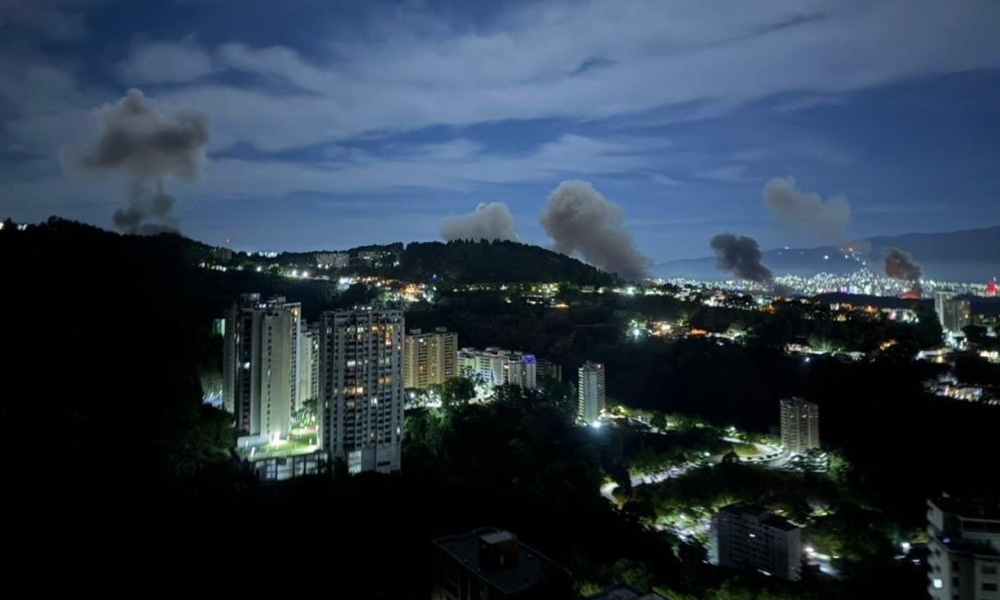
Loud explosions were heard in Caracas at about 02:00 local time, and plumes of smoke were seen rising over the city.

“I heard a huge sound, a loud bang,” reporter Ana Vanessa Herrero told the BBC. “It moved all the windows. Immediately after I saw a huge cloud of smoke that almost blocked the entire view.”

“Planes and helicopters were flying all over the city,” she said.

Soon, videos showing numerous aircraft in the skies — and others showing the apparent aftermath of explosions — began to circulate widely on social media. One showed a convoy of helicopters flying at low altitude over Caracas as smoke rose from apparent detonations.

“We woke up at around 01:55 to the roar of explosions and the hum of planes flying over Caracas,” one witness, Daniela, told the BBC. “Everything was plunged into absolute darkness, illuminated only by the flashes of nearby detonations.”

“Neighbours were messaging in the condominium group chat, all confused and unaware of what was happening [and] frightened by the blasts,” she said.

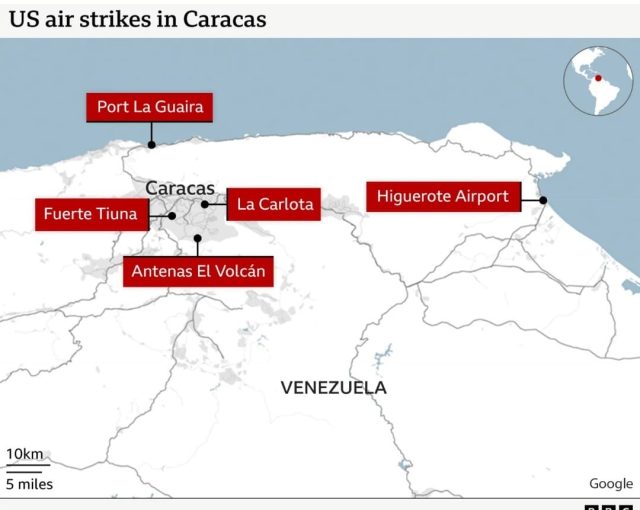
BBC Verify has examined a number of videos showing explosions, fire, and smoke in locations around Caracas to identify exactly which sites were targeted.

So far, it has confirmed five locations, including Generalissimo Francisco de Miranda Air Base, an airfield known as La Carlota, and Port La Guaira, Caracas.

Some of the US strikes targeted air defense systems and other military targets, officials said. Trump also suggested the US cut the power in Caracas before the mission began, although he did not specify how.

“The lights of Caracas were largely turned off due to a certain expertise that we have,” he said. “It was dark and it was deadly.”

‘They knew we were coming’

As strikes rang out around Caracas, US forces made their way into the city. They included members of the elite Delta Force, the US military’s top special mission unit, sources told the BBC’s US partner CBS. They were heavily armed — and carried a blowtorch in case they had to cut through the metal doors of Maduro’s safe house.

The troops arrived at Maduro’s location shortly after the strikes began at 02:01 local time, according to Gen Caine. Trump described the safe house as a heavily fortified military “fortress” in the heart of Caracas.

“They were in a ready position waiting for us. They knew they were coming,” he said.

The troops took fire when they arrived, and one of the American helicopters was hit but was still able to fly.

“The apprehension force descended into Maduro’s compound and moved with speed, precision and discipline,” Gen Caine said.

“They just broke in, and they broke into places that were not really able to be broken into, you know, steel doors that were put there for just this reason,” Trump said.

It was only as the operation — which also saw Maduro’s wife, Cilia Flores, seized — was unfolding that Secretary of State Rubio began notifying lawmakers about the action, a decision which has since prompted anger from some in Congress.

“Let me be clear: Nicolas Maduro is an illegitimate dictator. But launching military action without congressional authorisation and without a credible plan for what comes next is reckless,” said top Democrat Chuck Schumer, the party’s leader in the Senate.

Briefing Congress ahead of time would have endangered the mission, Rubio told reporters during the news conference on Saturday.

“Congress has a tendency to leak,” Trump added. “This would not be good.”

In Maduro’s compound, as elite US troops flooded in, Trump said the Venezuelan president — who has reportedly increased his reliance on Cuban bodyguards in recent months — attempted to flee to a safe room.

“He was trying to get to a safe place, which wasn’t safe, because we would have had the door blown up in about 47 seconds,” he said.

“He made it to the door. He was unable to close it,” Trump said.

When asked if the US could have killed Maduro, an authoritarian leader who took over the presidency in 2013, if he had resisted arrest, Trump said: “It could have happened.” On the US side, “a couple of guys were hit,” he said, but no US service members were killed. The Venezuelan authorities have not confirmed any casualties.

The US had previously offered a $50m reward for information leading to Maduro’s arrest. But by 04:20 local time on Saturday, helicopters were leaving Venezuelan territory with Maduro and his wife on board, in custody of the Department of Justice and en route ultimately to New York, where they are expected to face criminal charges.
Almost exactly an hour later, Trump announced the news of his capture to the world.

“Maduro and his wife will soon face the full might of American justice,” he said. (BBC News)

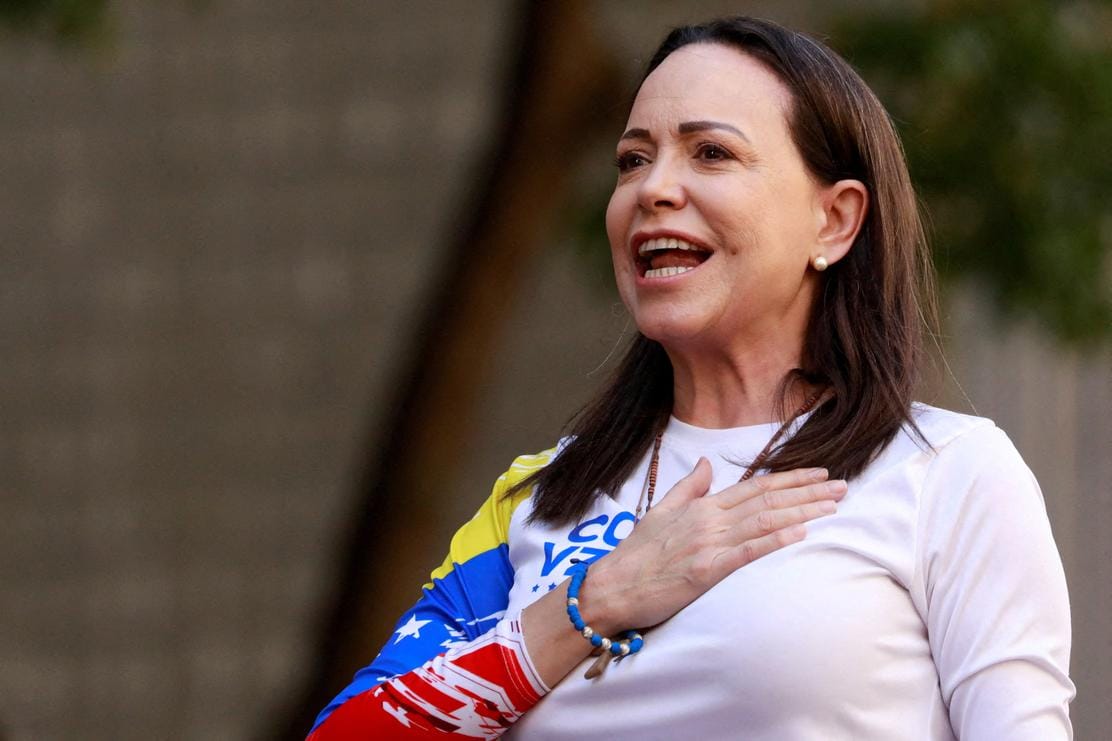
Venezuela’s opposition leader welcomes US intervention

The opposition leader of Venezuela – and Nobel Peace Prize winner – Maria Corina Machado has welcomed the US intervention, saying the country’s “hour of freedom” has arrived.

She said on social media that President Maduro was removed from power after refusing a negotiated exit, and the opposition’s candidate for the 2024 elections – Edmundo Gonzalez – should now “assume” the presidency.

She added the opposition would restore order in the country and free political prisoners.

Such a transition is certainly what the US wants. But it may not be as simple as the opposition claim.

Maduro still has allies in the country, many of whom may not want to go without a fight if they fear repercussions themselves.

Even some fierce critics of Maduro are uncomfortable with US intervention, fear this could lead to further destabilisation, and have not supported Machado’s close alliance with the Trump administration.

But, some critics see this as a final resort to get rid of what they believe was an authoritarian and oppressive regime. (BBC)

Multiple Explosions Rock Venezuelan Capital, Caracas

Venezuela’s government on Saturday condemned what it described as a “very serious military aggression” by the United States after explosions were reported in the capital, Caracas, and other parts of the country.

In a statement, the government accused the United States of carrying out attacks in Caracas and in the states of Miranda, Aragua and La Guaira.

President Nicolás Maduro has signed a state of emergency and ordered the implementation of all national defence plans “at the appropriate time and under the appropriate circumstances,” according to the statement.

The government also called on Venezuela’s social and political forces to mobilize in defence of the country.

“The people of Venezuela and their Bolivarian National Armed Forces, in perfect popular-military-police unity, are deployed to guarantee sovereignty and peace,” the statement said.

Venezuela said it would file complaints with the United Nations Security Council, the UN Secretary-General and other international bodies, seeking condemnation of the United States. (CNN)

Venezuela surrounded: Trump orders ‘total’ blockade of sanctioned Venezuela oil tankers

United States President Donald Trump has ordered “a total and complete” blockade of all US-sanctioned oil tankers entering and leaving Venezuela.

“Venezuela is completely surrounded by the largest Armada ever assembled in the History of South America,” Trump said in a post on his social media platform, Truth Social.

“For the theft of our Assets, and many other reasons, including Terrorism, Drug Smuggling, and Human Trafficking, the Venezuelan Regime has been designated a FOREIGN TERRORIST ORGANIZATION,” Trump said.

“Therefore, today, I am ordering A TOTAL AND COMPLETE BLOCKADE OF ALL SANCTIONED OIL TANKERS going into, and out of, Venezuela,” he added.

Trump’s comments come a week after US forces seized a sanctioned oil tanker off the coast of Venezuela, and as Washington ordered a major build-up of US military forces off the Venezuelan coast in an operation it said was targeting drug smuggling.

The US military has killed at least 90 people since September in attacks on dozens of vessels in the eastern Pacific Ocean and Caribbean Sea near Venezuela, actions that international law experts have criticised as extrajudicial killings.

Washington has claimed the vessels were involved in drug trafficking. (Al Jazeera)